
Where Battery Companies are Falling Behind in Digital Battery Passport Solutions Readiness
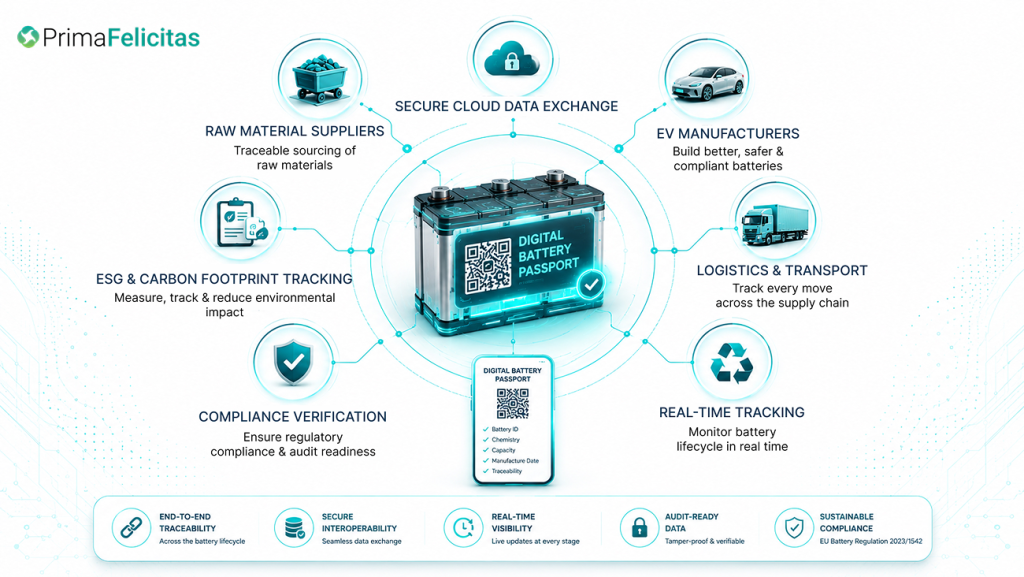
Audit-ready Digital Battery Passport solutions involve setting the right benchmark to ensure end-to-end battery traceability across the industry. Organisations that come under the EU Battery Regulations 2023/1542 are not just building a QR code linked to a battery passport, but also mapping the right strategies to build battery traceability solutions that align with the regulatory audits
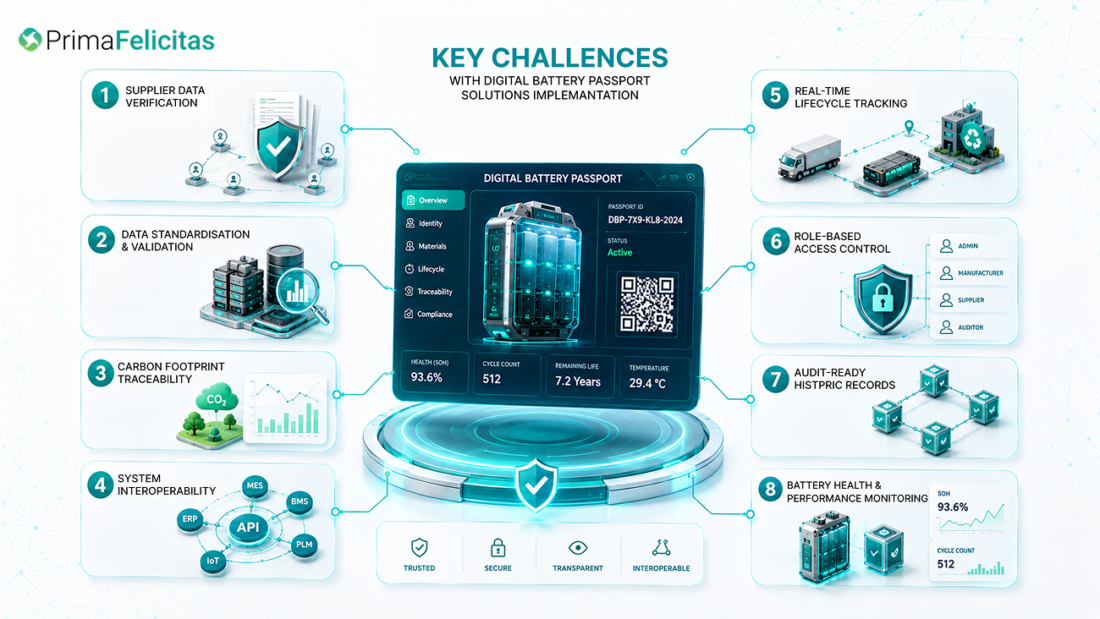
While many companies are busy collecting data, only a few have a strategic battery passport workflow. The real obstacles with the Digital Battery Passport are the accurate mapping of the scope, maintenance of unique battery identifiers, updates on ownership, verification of suppliers’ records, carbon footprint calculations, data standardisation, and integration of systems such as BMS.
Read on to explore in detail key challenges with Digital Battery Passport solutions implementation and how companies can ensure that they are audited ready before the 2027 deadline.
Key Challenges with Digital Battery Passport Solutions Implementation
Battery Passport creation involves multiple collaborations and is more complex than it seems. Here is a detail on what companies have been facing over the past few months with DBP implementation.
Data Collection and Management
EU battery regulations demand companies to share the following data-
- Traceability of raw materials
- Carbon footprint calculations
- Battery performance metrics
- ESG reporting
- Recycled battery content data
- Repair historic record
- Reuse or recycling information
- Details on the audit trials
These data are collected and recorded independently across the battery ecosystems among Miners, OEMs, cell producers, recyclers, and regulators. The challenges were-
- No standardisation for identifiers
- Suppliers unwilling to share data
- Inconsistency with carbon footprint traceability
System Compatibility
Companies run their independent systems, which include-
- Supplier portals
- Product Lifecycle Management (PLM) Systems
- Manufacturing Execution Systems (MES)
- ERP Systems
- ESG platforms
But how well they are connected end-to-end determines the seamless exchange of data across the battery lifecycle. Gaps that most companies see while running a pilot project are-
- Unclear ownership updates across the battery lifecycle
- Weak Data verification mechanisms
- System interoperability
Fragmented data and disconnected systems enable the company to focus not just on Battery Passport, but on the foundation that can cause audit readiness gaps-
- Suppliers onboarding
- Data Governance
- Data format and structure for interoperability
- Interoperability across the battery ecosystem
- Audit-level data traceability
Also Read: Is Your Digital Battery Passport Ready for Regulatory Audits
Access Control Mechanism
As multiple stakeholders are connected with the Digital Battery Passport solutions, the data varies. Some data act as battery identifiers, other battery-specific, and another set may be technical. Not all battery data needs to be accessed by all. The key challenges with defining access control mechanisms include-
- Managing role-based access battery ecosystem
- A massive dataset that needs to be analysed before granting access
- Compliance with EU regulatory regulations for data visibility
- Syncing access permissions across multiple organisations
Security Challenges
Certain data may be critical and sensitive to be shared across the battery lifecycle. The security challenges with data protection include-
- Exposure of sensitive data to unauthorised parties
- Unauthorised modification of battery lifecycle records
- Managing the evolving access rights
Battery Specific Data
One of the most challenging parts of battery traceability is recording State of Health (SoH), cycle count, remaining capacity, and maintaining records on repairing, repurposing, and second-life use.
These data are recorded and managed using Battery Management Systems (BMS) integrated with other systems and devices like the Internet of Things (IoT) devices.
Important factors to consider are –
- BMS and battery passport cannot be treated as two separate parts of battery traceability solutions
- Ensure real-time data synchronisation among systems
- Maintain a tamper-proof record of historic data
- A continuous record of data updates must be made available throughout the lifecycle
Connect with our experts at PrimaFelicitas to assess your Digital Battery Passport solutions readiness before the 2027 compliance deadline.
How Can Companies Prepare for Battery Traceability Solutions Audit Readiness?
Companies that have a roadmap and are moving ahead with Digital Battery Passport readiness can take an audit readiness assessment. An extensive analysis helps find gaps with data, interoperability, or execution to fix them at an early stage. Here is a detail on what companies need to focus on to ensure that they are audit-ready.
Regulatory Audit Readiness
This is what companies are trying to achieve with DBP implementation. The regulatory authorities are not only going to check if companies have a Digital Battery Passport, but also a set of other audits will follow up, such as-
- How the data is verified
- Complete historic record
- How is the carbon footprint calculated
- How is the suppliers’ data verified
- What is the control access mechanism applied
- Are the records tamper-proof
Companies need to ensure that they are ready with records as per the regulatory requirements.
Data Architecture Readiness
Companies that are facing challenges with data in DBP implementation must focus on-
- Digital Product Identifiers: Ensure that identifiers are not duplicated across batteries’ lifecycle.
- Supplier Data Management: Structure a systematic process to collect, validate, and standardise suppliers’ data
- Data Pipeline: Ensures a seamless flow of data across systems and end-to-end visibility through a connected data pipeline
- Traceability Frameworks: Build a battery framework to define how data will be captured, verified, and linked across the lifecycle.
- Data Governance Layers: Set rules for data ownership, validation, access control, and compliance.
The system architects, Chief Information Officers, and technologists must come together to set the right foundation for Digital Battery Passport solutions.
Also Read: Digital Battery Passport Power Play: How Early Movers Will Dominate the Circular Economy by 2030
Supplier Data Collection & Validation Readiness
Companies must prepare a structured process to-
- Identify incomplete, inaccurate, and non-verifiable supplier data
- Validate and standardise data collected from multiple suppliers. Without effective collaboration, data traceability is incomplete across the battery lifecycle.
- Ensure that suppliers follow a consistent data format and standards to be readable across systems
- Build systems to ensure continuous verified data exchange across the connected systems
Role-Based Access Mechanism
Implementing the right access control mechanism is critical, as it requires a deeper understanding of data. Here are things to consider when managing accessibility with DBP-
- The data must be mapped based on its criticality
- A strong mechanism must be applied to ensure precise visibility across the battery lifecycle.
- Role-based permissions must be defined clearly
- Ensure that suppliers, OEMs, recyclers, regulators, and service providers are aligned with accessibility.
Building a battery traceability system framework? Let’s help you identify audit readiness gaps across data, systems, access control, and security. Contact us at PrimaFelicitas.
Why Battery Traceability System Requires Cross-Functional Collaboration
Battery traceability is not the responsibility of a few stakeholders across the ecosystem. It is also not just about compliance and initiative for sustainable development. Full traceability depends on accurate, verified, and continuous updates of data flowing across the battery lifecycle.
The data originates from different systems across companies, hence teams cannot work in isolation. Have a look at the roles and responsibilities of different teams to build an audit-ready DBP system.
- Sustainability team: They are responsible for carbon footprint calculations, ESG disclosures, reporting on sustainable practices with battery manufacturing and recycling, and ensuring that data aligns with EU Battery Regulations.
- Compliance team: They ensure that the collected data meets the audit and regulatory requirements, is well documented, and that a strong verification mechanism is followed.
- Supplier management team: They play a crucial role in ensuring that the data related to raw materials is complete and verified. Audit readiness is incomplete without suppliers’ participation.
- System architect and IT team: This team looks after interoperability for seamless exchange of data. They focus on designing the best system architecture and integration of multiple systems such as ERP, BMS, IoT devices, PLM, MES, and more.
- Security team: They are responsible for ensuring that the systems are secure, audit-ready, and scalable.
- Supply Chain and Logistics Team: They maintain records of the battery storage, movement, ownership updates, transportation, repair, or repurposing of a battery
- Recyclers: They produce data on battery repurposing and recycling at the end of their life span or second life usage.
- Technical engineering team: They contribute to ensuring the technical metrics, such as battery health (SoH), performance, chemical compositions, cycle count, and repair history, are traced throughout its usage across the battery lifecycle.’
These teams, along with regulators, need to collaborate and build a digital battery passport system that is not fragmented.
Without effective coordination, the system cannot function with an inconsistent data structure, a lack of a verification process, and audit readiness gaps.
Why Companies Should Collaborate to Take a DBP Audit Readiness Assessment
We can see that digital battery passport solutions implementation involves multiple steps and collaborations. Aligning everything from data collection to interoperability with regulatory audits requires a strategic roadmap and a complete understanding of traceability requirements. Taking an extensive audit readiness assessment helps-
- Analyse if the roadmap aligns with regulatory requirements
- Identify gaps with data
- Check for system compatibility and interoperability
- Ensure scalability as the battery ecosystem expands
- Evaluate for a role-based access mechanism
- Trace security loopholes across the battery lifecycle
Early movers have already run pilots to have a clear picture of battery traceability solutions. Others are companies that are ready to take an assessment test to fix gaps before regulatory audits. But there are still a certain percentage of companies that are lagging due to a lack of clarity.
Why Early Movers Will Gain Competitive Advantage in Battery Compliance
Early movers are strategic leaders and compliance followers who are running a pilot or taking a comprehensive audit readiness assessment to fix gaps early and meet the deadlines. They will gain a competitive Advantage with-
- Time and effort saved in fixing gaps before regulatory audits
- Early access to the EU market
- Builds trust with partners and consumers
- Better collaboration with structured data and standardised processes
- Reduced compliance risk with connected systems.
For early movers, DBP is becoming a competitive advantage.
Still evaluating your DBP data and strategy? Let’s connect to build a clear roadmap for an audit-ready battery traceability system
Also Read: Unlock EU Battery Traceability Regulations: Key Highlights for Businesses, Regulators & Consumers
Wrap Up!
The successful implementation of the Digital Battery Passport is about building a connected framework where each stakeholder needs to contribute their part. The aim is to build unified battery traceability solutions with Digital Battery Passport as the operational foundation.
Preparing for Digital Battery Passport compliance? Reach out to our team at PrimaFelicitas to explore how your organisation can strengthen traceability, interoperability, and audit-ready data workflows.
