
EVs Are Clean, But Their Real Soul is battery traceability, something we barely understand
Battery traceability is playing a critical part in the next evolving EV ecosystem. Something is interesting about how we experience EVs today. The scenario shows complete visibility and a controlled system. Every process is manageable, whether it is the charging rate, performance, or even managing parts through digital tech. As compared to traditional systems, it feels really transparent, which is almost like nothing stays beneath. And maybe that’s exactly what establishes trust easily. It strongly gives the assumption from the surface level that everything is efficient, optimized, and clean at every level. The whole experience is smooth, but there is one thing we need to look beyond the surface: there’s one part of the system that we rarely question.
“THE BATTERY,” but this is not in terms of specification or performance metrics, but rather the process, meaning the stages through the EV battery lifecycle management.
In simple terms, it’s the production and making of batteries, then reusing them over the power of time. What really happens to it beyond everyday usage? While the interface shows a smooth workflow, the lifecycle behind it does not always offer the same clarity. And that’s where it becomes an uncleared gap.
The Illusion Of Transparency
Ease of trust comes from visibility, not the rate of it. This is how EVs work; they show the optional operation to an extent that feels measurable and controlled. But over the period of time, it creates a sense of complete understanding that whatever we are seeing is only on a surface level. It is designed to check battery performance, but not necessarily show how it shows capabilities over time, the conditions under which the battery performs, and how those factors might influence its future reliability.
In simple terms, we are actually exposed to the simplest aspect of a complex system. The deep layers include manufacturing variations, the origin of materials, and long-term degradation; along with that, a detailed history of the particular battery remains out of sight. And that’s where the visibility on the surface is disguised as complete transparency, even when critical aspects are still not clear and connected. So while EVs are getting that level of awareness, at the same time, a significant part remains unchecked. This is the right moment when battery traceability is required, not just for the sake of the recent EU battery regulation 2023/1542. Rather, a technical value addition to the system that is scaling and will help a mass economy.
The Battery As A Black Box
At the core, it is the battery because it is the most critical part of the entire system. And yet, after the above information, what we have understood is that it acts as a black box. We know the battery has been installed and then charged to some extent, but at the same time, it shows the performance and efficiency. Both input and output can be observed, but the process in between is not always clearly understood outside a limited layer of metrics.
Two batteries under different conditions will show similar performance on the surface level, but in reality, there is a huge gap between visible performance and actual condition that starts to matter. Battery something that cannot be just passed based on outer analysis, and deep operation is needed because understanding its true state becomes more interpretive than precise. That’s where it feels like a black box.
You can see it, measure it, and make an assumption only on the available data, but the big picture cannot come on the basis of a structured or consistent way. And as long as that remains the case, our understanding of the battery stays partial, even if our interaction with it feels complete. To keep reliable data on point, a battery tracking system becomes essential; it will not just show the level or ratings. Rather, keep everything intact to keep a view of the battery’s entire life cycle from production to recycling. Without a structured system, it is just a part of visibility, but not the clarity of the entire interaction battery across stages.
Why This Gap Actually Matters
At first, it seems like a technical detail, but something that is deeply embedded in the EVs does not affect the everyday experience. But once you start thinking, then it connects the dots in the practical sense. Take something as simple as trust over time. When an EV is new, its performance is easy to analyze, but after years, its performance does not rely on battery current metrics. It is the battery history; without that context, long-term reliability becomes less certain.
This is the same level of understanding that comes during changing ownership; for instance, if it is a resale scenario, the EV’s value is tied to the condition of its battery. Understanding of that battery depends on the limited surface-level data, so both buyers and sellers will remain misinformed. They eventually lose interest, and there can be a situation of undervaluation of assets that still hold potential. This is all because of battery traceability, which can directly affect decision-making. Beyond the resale narrative, there are safety concerns that must be taken into consideration.
What we are exactly talking about here is that different batteries come through different conditions, and those patterns are irregular. How much stress, pressure, and usability rate for different batteries? Without a clear view of their lifecycle, it is difficult to understand the potential risk, and it is really necessary to make them go from reactive to proactive.
After that, the question comes to sustainability. The battery, after being used 100 times still valuable in secondary life applications such as stationary energy storage. Again, it needs structured data touchpoints related to the battery usage and the conditions under which the battery gets degraded. Without that level of access to each dataset, decision-making tends to become conservative. It leads to early battery replacement or reusing without sufficient insight. This is where a connected battery traceability system becomes an essential part of the system. Then the system will provide accuracy, confidence, and scalable decisions across the lifecycle. Afterwards, there will be a fine gap between visibility and understanding. At first, that can be subtle but begin to compound and influence multiple parts of the ecosystem.
How Battery Data Breaks Across the Lifecycle
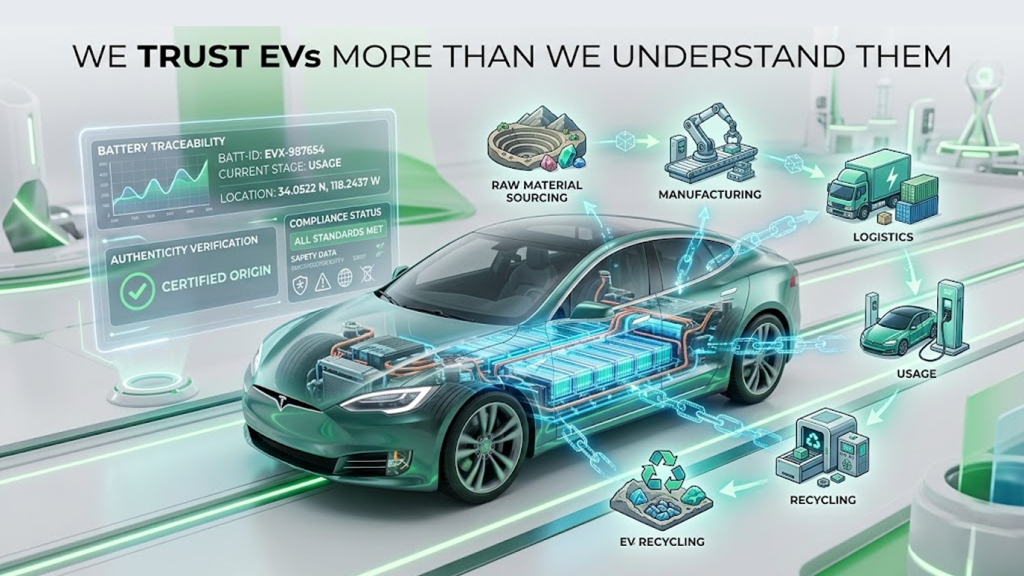
There is a core problem that lies beneath the EV battery management, and keep on getting more complex over time. It is important to look at the core. Yes, it will take time but once it gets set, then information will flow smoothly alongside it. As you know, EV batteries are not limited to a single system or organization. It started when it was just raw material, including lithium, cobalt, and nickel, coupled together, and processed. From there, the real product starts to take shape as a crucial part of the EV. From there, the battery enters the usage phase, where it operates under a dynamic environment. After sometime its potential reaches that extent where it transitions into the resale market, like stationary energy storage. Eventually, the battery reaches recycling or disposal stages.
This is the stage where every stakeholder gets involved, and each works in their own systems and processes:
- Raw material suppliers
- Battery manufacturers
- EV manufacturers
- Logistics and supply chain providers
- Energy storage companies
- Recycling and recovery players
These areas through which the battery keeps moving gather a lot of data with it, which may not follow the same path with consistency.
To keep that consistent, data must be moved with transparency along with the calculative privacy during different processes. So that the data cannot be manipulated during production, testing, and deployment. It is not like trapping the data into a system, but rather moving through those systems; otherwise, it leads to fragmentation. After that, that data cannot be linked in a meaningful or accessible way that makes in reliably difficult for an ecosystem where battery history and conditions are necessary.
It is necessary from a practical standpoint because it will help decision makers during battery usability (reused, repurposed, or recycled), depending on the accurate data. Otherwise, inefficiency creates partial insights, and with millions of data points together, can create a ruckus. To align all the jumbled data sets, a structured battery traceability system becomes unavoidable. Why? The answer lies in the coordination that creates a flow of information, creating an interconnected context across the entire ecosystem.
A well-framed battery traceability creates a lifecycle where every stakeholder gets equal access; on the other hand, a robust battery tracking system establishes complete visibility. Together, they enable more reliable and scalable EV battery lifecycle management, ensuring decisions are based on complete and trustworthy information.
Does the Battery Traceability Act act as the connecting layer?
Until now, battery data breaks across different stages and stakeholders; the question naturally comes up with the following: how can it be more connected and reliable? It is not something solved by just improving individual systems alone but by creating a layer that connects them. For that, there should be something that keeps a verification on each data point. Let them flow across the chain to create an interlink between sources; that is where battery traceability starts to play a critical role. The system does not create a separate data point at each stage but rather focuses on creating continuity. It ensures that all information at each stage is accessible and meaningful in the next. Whether the stages are from raw material sourcing to manufacturing or vehicle usage to second life applications and eventually to recycling.
In total, the entire fragmented data transforms into a continuous lifecycle narrative. A well-designed battery traceability system empowers stakeholders with a shared understanding of battery data touchpoints. This automatically increases our understanding of the context through the battery’s history and condition. Eventually, improve the decision-making during different processes like reuse, repurpose, or end-of-life handling.
To strengthen it, the battery tracking system reinforces the system to analyse performance from both physical and digital points of view. Technically, merging will not just establish operational efficiency but also build a connection, a never-ending trust. Once the data moving through systems is connected, then those become easier to access and wisely utilize. Now, the battery operates as a self-evaluating system, exhibiting greater clarity and confidence.
The system enables a well-coordinated environment in which the stakeholders will work with complete information. This eventually creates a foundation for scalable EV battery lifecycle management.
Digital Battery Passport: Moving Toward Lifecycle Transparency
Till now, it is clear that there is a need for visibility into the lifecycle of battery data, and demand keeps on multiplying. Industries are specifically moving towards a structured way to manage battery information across their lifecycle. Industries were thinking and developing a concept, but now it has become a reality: the digital battery passport.
The core is not only to track the data but also to create a structured, persistent presentation of easy and smooth data records. From production to second-life usability, many informations are crucial and detailed under a single battery. So the intention is not just to store data and show the technical advancement but to make it accessible, verifiable, and usable across different stakeholders.
Keeping all the data beautifully organised is a priority, but the foundation for battery traceability is a standardised, interoperable layer. And that can be managed by a digital battery passport, which can be easily interpreted and applied in real-world scenarios. It is necessary to work with both because that will keep the relevance in the context of evolving regulations and sustainability. It is not just a requirement for the sake of technological advancement but a necessity to have a system that carries verifiable values.
This is not so easy to implement the digital battery passport because it requires alignment among stakeholders, mutual agreement, and data standards. All of these will be calculated and built into the battery traceability systems. Without this coordination, even well-designed frameworks may struggle to deliver their intended value. That level of coordination given by someone who is into the technological, Primafelicitas, can empower the battery industries with their traceability expertise and understanding. The experts have been working for decades to maintain a reliable tracking system for valuable sectors.
They can help in end-to-end implementation, where they can improve EV battery lifecycle management. The management will be so organised that it enables better decisions, reducing inefficiencies, transparent and accountable ecosystem.
Something to Think About
With improvements, EVs are becoming more sophisticated and easier to rely on. But with increased adoption, the question of whether they perform well or not is not only the issue, but also whether we know how they work over time. This system has the battery in the centre, but due to the nature of its lifecycle, most of it is still partially visible. This is more difficult to disregard as the scale grows. The battery traceability and techniques, such as the digital battery passport, begin to lose their optional character and become more of a requirement.
