
Digital Battery Passport: Latest News & Global Sustainability Initiatives
Batteries, an essential source of energy to power a wide range of electronic devices, are gaining attention due to their recent development in areas like the Electric Vehicles (EVs) segment and usage in industrial systems. In the coming years, the use of batteries will grow, especially with the rapid expansion of electric road transport vehicles. According to a report by Statista, the overall demand for electric vehicle batteries is expected to reach 6,530 gigawatt hours in 2050. Thus, the strategic use, recycling, and disposal of batteries are crucial to support sustainable development, the use of clean energy, green mobility, and climate neutrality.
Looking at the strategic significance of batteries, various initiatives have been taken globally. One of the important initiatives is the Digital Battery Passport. The European Union (EU), China, and multiple stakeholders are supporting the Global Battery Alliance (GBA) or the Battery Pass consortium initiative for the development of a digital product passport.
How does this step mark a strong initiative towards transparency and sustainability in the battery industry? Let’s discuss in detail.
Global Battery Alliance (GBA): Sustainable Battery Value Chain 2030
The Global Battery Alliance (GBA) is a public-private collaboration among 140+ leading international organisations, NGOs, industries, academic institutions, and governments to achieve a sustainable battery value chain by 2030. The Battery Passport initiative is one among many initiatives to support global sustainability. Key Objectives-
- Define a global criterion for battery usage, recycling, or disposal
- Set a benchmark for battery data traceability
- Maintain transparency in the battery market
GBA envisions Battery Passport by 2030. It is widely adopted by industries and associated certification organisations globally. By implementing the GBA Battery Passport, organisations worldwide aim to demonstrate-
- Commitment to sustainability
- Add value and trust among stakeholders
- Maintain supply chain transparency
- Comply with regulatory requirements
- Enable buyers to make an informed choice on battery product purchases
- Release verified battery products comparison
- Enable mineral-rich countries to prepare and support global regulations
Interested in discussing more about Digital Battery Passport (DBP) projects? Let’s connect to exchange ideas and explore collaboration opportunities. Contact PrimaFelicitas.
EU Battery Regulations News: Key Highlights & Targets 2027
The Battery Regulation (EU) came into force in August 2023. The regulations aim to ensure sustainable practices throughout the battery lifecycle sold across the EU. The long-term goal is to reduce the carbon footprint, minimise material wastage, and encourage the recycling process. Check EU battery regulations news: latest updates and highlights-
Battery Passport Implementation
By February 18, 2027, industrial batteries and all electric vehicles (EVs) with a capacity of more than 2 kWh in the EU market must have a digital battery passport that can be accessed via QR code.
Due Diligence Obligations
The EU has extended the date by 18 August 2027 to allow manufacturers and economic operators enough time to prepare for-
- General battery manufacturing process
- Certifications and documentation
- Supply chain traceability
- Circularity and resource efficiency data
- Battery performance and its durability data
- Compliance check
Recycled Content Requirement
The regulation mandates that by August 18, 2031, all batteries must be placed in the EU market with DBP. It includes recycled content thresholds for lithium, nickel, cobalt, and lead.
Manufacturers are required to implement due diligence policies throughout the raw materials
supply chain, such as lithium, cobalt, nickel, or graphite. They must ensure that the extraction process is traceable, ethical, and environmentally safe.
If you are exploring Digital Battery Passport initiatives or working on sustainable solutions, connect to discuss potential collaboration opportunities with PrimaFelicitas.
Chinese Digital Battery Passport Initiative
Following the EU Battery Regulations, China announced a comprehensive Chinese digital battery passport plan, keeping the EU Battery Regulations as the reference and integrating its existing standards on battery lifecycle data.
Chinese Battery Passport Guidance
It defines-
- Ecodesign for sustainable products regulation (ESPR)
- Battery passport content guidance
Chinese Battery Passport Standards
- Generate Battery Passports that comply with EU regulatory requirements. The aim is to facilitate export compliance and strengthen trade with the EU.
- Explore China-specific standards in alignment with Europe and international frameworks.
Key Initiatives –
- Provide essential infrastructure services to the battery value chain.
- Evaluate performance standards for retired power Lithium-ion Batteries for public consultation
- Encourage stakeholders across industries to review and provide feedback on standards
- Maintain data transparency across the EV battery value chain in China
- Track carbon footprint
- Measure circularity
- Ensure that the ESG framework is followed
Digital Battery Passport is a long-term commitment for organisations to align with climate goals. Global communities need to support this to ensure that the use of energy source devices and materials used supports sustainability.
Know the Co-founder and CEO at PrimaFelicitas thoughts around Digital Battery Passport-
Battery Lifecycle: Stage Wise Use Cases Digital Battery Passport (DBP)
The successful implementation of the Digital Battery Passport (DBP) involves multiple stages. Let’s discuss them one by one –
Stage 1: Raw Material Extraction |Miner or Refiner
It involves the documentation of the use and extraction of raw materials such as lithium, nickel, cobalt, and graphite in the manufacturing of batteries. Role of Digital Battery Passport at this stage-
- Verifies whether the Environmental, Social, and Governance (ESG) compliance is met or not
- Traces the origin or source point of raw material
- Assists the auditing team in determining the sustainable procurement of raw materials
Stage 2: Cathode Active Material (CAM) | Precursor and Producer
The raw material is refined and converted into battery chemical components that are further used in the battery cells. Why Digital Battery Passport matters in this stage-
- Helps analyse data and fetch useful insights on the materials used
- Assists the team in maintaining supply chain transparency
- Ensures that verified ESG-certified raw materials are used for battery chemical components
Stage 3: Cell and Modules Manufacturing| Producer
This stage involves the manufacturing of cells and modules used in Electric Vehicles (EVs) and other energy storage devices. Digital battery passport helps-
- Analyse the chemistry of the chemicals used in the battery
- Enables an authorised person to audit the manufacturing data
- Assures the performance of the battery with verified data
- Helps improve the overall design and production of EV batteries with relevant data
Stage 4: Original Equipment Manufacturer (OEM) | Integration Stage
In this stage, the energy storage device and EVs manufacturing companies, such as Tesla, BYD, Tata Motors, to name a few, integrate batteries with devices. Significant role of digital battery passport, in this step-
- Assists the team with comprehensive supply chain visibility
- Keeps a verified record of the lifecycle of materials and batteries for traceability
- Supports circular economy initiatives. It involves documentation of reuse, repair, and recycling data and process documentation, and taking essential steps to minimise wastage
Stage 5: Consumers or Owners| Electric Vehicles or Devices
Electric Vehicles (EVs) and other energy storage devices are finally ready to be used by consumers. How does the digital battery passport empower consumers-
- Helps consumers track the battery’s health. It is useful to define the State of Health (SoH) of the battery, a percentage metric that indicates the current capacity of the battery, as well as its power and resistance, and compare it with the original specifications.
- Tracks the performance of the battery and its usage.
- Assists consumers in making informed purchasing decisions about EVs and other battery-powered devices.
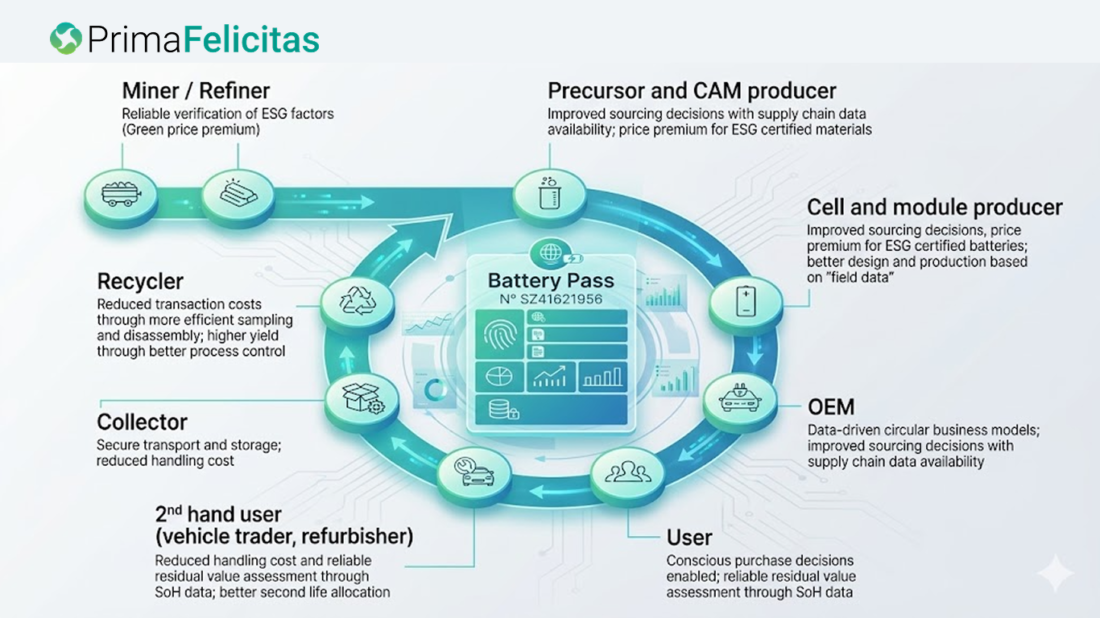
Stage 6: Second-Hand Traders | Electric Vehicles or Devices
The digital battery passport supports sellers, traders, and buyers interested in buying or selling second-hand batteries. By using relevant data, the battery can be repurposed based on the estimated residual value.
What data does a digital battery passport provide?
- Verified battery health records
- Full battery lifecycle data
- The data enable buyers to estimate the appropriate value
Stage 7: Collectors| End of Battery Lifecycle
This stage marks the end of the battery’s life. The collector can use these batteries to extract useful materials and utilise them according to their value. Know how the digital battery passport supports the collectors:
- Track the location of the battery using unique identities (IDs)
- Provide collectors with ownership information
- Ensure that the battery is stored at safe place
- Provide guidelines and conditional requirements for its safe transportation
- Provides comprehensive information to help extract valuable materials used in batteries
Stage 8: Recycling Phase | Final Stage
The collectors extract useful materials from the battery and then pass them on to a recycler for safe disposal or repurposing. The battery passport simplifies the process by–
- Providing data on the exact composition of materials
- Assist recyclers in dismantling batteries conveniently
- Ensure higher material recovery rates
- Optimise the recycling process to lower the processing cost
Also Read: Tokenising of Carbon Credits for a Sustainable Future
Wrap Up!
The implementation and support for the battery passport project show the commitment towards sustainability while meeting the country specific regulatories. With relevant data related to the battery utility and availability, the mineral-rich countries can plan better to support the EU Batteries Regulations initiatives. Moreover, consumers can compare devices and vehicles that run on batteries to make informed decisions on purchasing.
Connect with our blockchain experts at PrimaFelicitas for a detailed conversation around sustainable development, digital battery passport projects, and initiatives.
Frequently Asked Questions (FAQs)
1. What is an EU Digital Battery Passport?
The Digital Battery Passport is a digital record that tracks and traces detailed information related to the battery’s lifecycle. It includes the origin and source of raw material, battery performance, health, battery recycling data, and more. The aim is to promote the sustainable use of batteries throughout their lifecycle, maintain transparency, and ensure traceability and accountability.
2. How is the Digital Battery Passport significant in supporting sustainability?
Digital Battery Passport encourages battery materials suppliers, manufacturers, recyclers, and others to take responsibility and keep track of practices when it comes to battery manufacturing, use, reuse, recycling, or disposal.
The data and insights collected help improve recycling efficiency, support circular economy practices, and ensure compliance with sustainability regulations.
3. Is it mandatory to implement the EU Digital Battery Passport?
Yes. As per EU battery regulations, by February 18, 2027, industrial batteries and all electric vehicle (EV) batteries with a capacity of more than 2 kWh in the EU market must have a digital battery passport. The passport must be accessible via QR code.
4. Is Digital Battery Passport beneficial for companies and consumers?
Businesses and companies can benefit from verified records, fast and real-time traceability of data, and supply chain transparency.
Consumers can gain useful insights such as battery performance, source of materials, and health of the battery to make informed decisions.
5. What data does a Digital Battery Passport hold?
The Digital Battery Passport will have manufacturers’ Information, battery features information such as capacity, performance, and health, source or origin of materials,
carbon footprint data, battery recycling content, data access control, regulations, and more.
