

- Posted on
- PrimaFelicitas
- 0
Why Wearable AI Is Becoming the Next Human-Centric Enterprise Intelligence Layer
The coming years will be something beyond dashboards, automation platforms, and centralized intelligent systems. The next thing is Wearable AI, which is already taking a step back to take a long jump into the enterprise. This is the time when enterprises are actively seeking the next competitive edge, as it has been a decade since they have been looking for the same level of computational execution. They are collecting more data, improving analytics, and deploying AI models that guide once the work is finished.
Now it is a saturation point where everything is going to its limit, but you know every last point is the new start, so the next phase of enterprise intelligence is forming closer to the real point of occurrence, like people, in motion and in real-time. This is where Wearable AI is gaining a lot of attention from enterprises, but not as a device category, but as a strategic enhancement within the system. When intelligence moves to the human body, then this smart wearables station comes close to context, like physical activity, environment, workload intensity, fatigue, attention, and situational risk. This context changes how decisions are made, how operations are managed, and how productivity is measured. Intelligence is no longer delayed, aggregated, or abstracted. It becomes continuous and situational.
Market projections highlighting a $166B opportunity by 2029 reflect more than consumer adoption or gadget upgrades. They signal a deeper transformation in how enterprises design intelligence itself. Wearable AI enables a distributed model where humans become part of the enterprise sensing and decision fabric rather than endpoints feeding centralized systems. This redefines the relationship between people, technology, and operations.
For enterprise leaders, the opportunity is not simply to deploy AI wearables, but to redesign strategy, operations, and governance around human-centric intelligence. Organizations that approach wearable AI as an architectural shift rather than a technology purchase will unlock new levels of operational awareness, workforce augmentation, and resilience. This blog explores why that opportunity exists, what is changing inside enterprises, and how leaders should prepare to capture value responsibly over the coming years.
Why Wearable AI Has Reached an Enterprise Inflection Point
Wearable AI has been around in various forms and has been taken as a serious business only lately. The tipping point isn’t novelty; it’s convergence. Advances in on-device processing, edge AI, tiny sensors, and better power utilization make it possible to run intelligence continuously without constant cloud contact. In the meantime, there is also growing pressure on firms to improve productivity, safety, and the speed of decision-making within an increasingly complex environment. Traditional enterprise AI is incredibly powerful, but it sits apart from real activity. Data flows from people and processes into centralized platforms where insights are produced and sent back as recommendations. That creates latency and abstraction: By the time leaders or frontline workers get intelligent guidance, conditions may have already shifted. Wearable AI bridges that gap by bringing intelligence right to the point of action.
A related accelerant is how work itself is changing. Enterprises now cope with distributed teams, fluid environments, and more variable workloads. Static processes and periodic reports can’t keep up. With wearable AI, we can track what’s happening in the world, so the systems can adapt as events evolve rather than react after the fact.” Here is where the momentum begins, and it is being driven by the corporate world rather than consumer products.
Consumer products may have proved the notion, but the truth is that the momentum is becoming more and more driven by use cases in manufacturing, logistics, healthcare, and field services. “The value that really comes out of AI wearables is risk reduction, productivity, and decision support,” and as such, the process that is currently underway presents a decision that has only one correct answer when considering corporate applications. “Do we just bolt it on as we’ve always done, or is it an entirely new layer that changes how that work is defined and managed?” The answer should be the latter. The size of the opportunity reflects how many organizations are already recognizing that distinction.
What Wearable AI Really Means for Enterprises
Beyond Devices: Intelligence Around Humans
AI on the body is not about technology. Of course, there will be watches, glasses, bands, headsets, but that is just the delivery mechanism,” he said. The true paradigm shift is making intelligence serve people, rather than hiding it behind closed systems. “The shift is one of making intelligence serve people rather than hiding it. With wearable AI, sensing, intelligence, and smart feedback are seamlessly integrated into the workflow. No scribbled reports left in the wake, instead, you see the whole play of work in real time. Movement, environment, cognitive load, and actual risk are all intricately intertwined in the tapestry of intelligence. Work becomes a real-time signal in the system, rather than a data point from yesterday’s history.
In a kind of industry where there are heavy operations, a transformation of this nature can be quite drastic. Danger points can be identified even before they cause any issues. Points of bottleneck will make themselves known at the time they occur and not after weeks on a dashboard. The guidance a transformation provides here comes from the present, at a time when a choice has to be made. Intelligence is no longer something People look at, but rather something that helps them in their operations. This is why wearable AI has to be considered a system-wide strength. It is what connects people, processes, and environments in an endless loop of understanding. First movers begin to change their minds about how intelligence is distributed in the enterprise. They no longer find value in keeping all this intelligence in a system silo. They begin to leverage human-centric intelligence distributed in support of the larger system. The benefit is not about disrupting platforms; it’s about applyingenterprise intelligence where it’s never been before.
From Data Capture to Continuous Context Awareness
Traditional enterprise data models are event-driven and record events as they occur—transactions are logged, actions are recorded, and outcomes are analyzed after the fact. But wearable AI turns this on its head with the concept of continuous awareness.” Such systems monitor patterns, states, and changes occurring over a certain period of time, as opposed to being concerned with discrete points. Why this is important: most issues don’t come crashing down at the same time. Fatigue is an escalation that happens incrementally. Environmental issues wax and wane. Inefficiencies occur on an hour/daily basis. It is only after the issues come up that companies will address them, and that is what is missing from having constant context: the ability to address the issue before something massive happens.
Also impacted by the context-aware model is the format in which decisions are considered. Rather, in the context of decisions, the inquiry would not be, “What happened?” Rather, it would be, “What’s happening right now, and what’s likely to happen next?” While this awareness exists, there exists a new set of responsibilities. There exists a need to identify what signals to take into consideration, how this information can be derived, and how to act upon this knowledge. Without any proper structure, rich context information can rather confuse than help. That is where architectural discipline can help.
The company Primafelicitas can assist in developing AI-enabled devices, which can make use of constant context information to create valuable information. When done with purpose, real-time context awareness can become a competitive advantage in itself. This allows an organization to react to realities in a time frame that would be impossible with the reaction capabilities of a centralized system in their processing capabilities.
Wearable AI as a New Operational Intelligence Layer
Real-Time Decision Support At The Human Edge
Operational intelligence has been controlled centrally, where data is captured across systems in batch format and monitored through a dashboard or reports. These decisions cannot be delivered across a changing environment because that creates pressure on the system. So, Wearable AI comes into play, where it acts as a complementary model that takes real-time decisions while supporting human intention. When intelligence is embedded into AI wearables, decision support becomes immediate and contextual. Every frontline employee is no longer dedicated to the instructions that are generated far from the action.
Instead, these intelligent models receive guidance that comes from currency hanging scenarios, environment, physical state, and task complexity. This does not remove human judgment but refines the decision while removing the uncertainty. For instance, during the manufacturing process, the new approach will inform the workers about the worst situation before it exceeds its saturation point. On the other hand, in the case of healthcare, it can assist clinicians by quickly indicating the daily patterns and finding out the bottleneck before it persists further. Across these executions, it has been clear that a valued output lies in getting faster, better, and informed decisions.
After all these, real-time decision-making reflects a moment of accountability because guidance is bound to changing situations and adaptive, so the enterprise must reevaluate the thought behind the decision. Success is no longer addressed by a predefined procedure but by an outcome that is achieved through informed adaptation. This brings a strong take onenterprise AI implementation because of its different key components, like explainable, auditable, and perfectly aligned with organizational intent.
Designing such systems requires architectural maturity; it cannot be achieved by acquiring entire knowledge rather needs some structured approach. If it does not happen, then the enterprise will keep the risk of deploying fragmented tools that are quite out of context and provide alerts without insight. Organizations that partner with system-level AI specialists such as Primafelicitas are better positioned to integrate real-time decision support into already in-built operations without disrupting trust or workflow.
How Operations Change When AI Moves With People
When AI moves with people, operations shift from static coordination to dynamic orchestration. The traditional system is bound to a limited and stable environment with standardized roles, predictable flows of work. Wearable AI changes the perception and introduces variability-aware intelligence that perfectly synchronizes with condition change. These impacts help in the decline of operational blind spots. The managers will gain visibility into the core of work across time and space rather than focusing on just checkpoints. This allows for proactive correctness and can help in resource allocation rather than logging, the enterprise will act on lead while involving human activity seamlessly.
Another shift organizations are watching is process design, where they no longer expect something to happen rather their adaptive guidance that responds to context. The real potential of flexibility is shown in complex environments where rigid workflows break down. Wearable AI provides equilibrium across different standards, like adaptability, maintaining standards while accommodating real-world variation. However, those benefits can be boosted when wearable AI is deployed thoughtfully.
Treating it as an isolated layer makes an environment full of friction and confusion. Operations must be redesigned to incorporate continuous intelligence brainstorming to keep a flow and make a path for AI and humans to support each other’s roles. This is where enterprise-wide coordination becomes essential. As operations evolve along with the leadership, managers are transforming from overseeing compliance to shaping conditions for effective decision-making. This is the main core of the wearable AI that supports this transition by gathering richer insight into operational reality. Enterprises that realize and adapt gradually will be better equipped as well as scale performance without compromising resilience.
The Strategic Opportunity Hidden Inside Wearable AI
The real value of wearable AI is often misunderstood because it does not announce itself through dramatic process overhauls or visible system replacements. Instead, its strategic impact emerges quietly, through how enterprises begin to sense, interpret, and respond to reality faster than before. Wearable AI introduces a form of intelligence that is embedded in human activity itself, allowing organizations to see patterns, risks, and opportunities that were previously invisible or delayed.
This creates a strategic opportunity that extends beyond efficiency gains. Enterprises gain the ability to reduce decision latency, improve resilience, and align operations more closely with real-world conditions. Over time, this changes how value is created, not through larger systems or more data, but through better-timed, better-informed action. Leaders who recognize this shift early understand that wearable AI is not a tactical upgrade. It is a strategic lever that reshapes how productivity, safety, and competitive advantage compound across the organization.
Productivity, Safety, and Decision Velocity
The strategic value of wearable AI does not come from incremental efficiency gains alone. It comes from how productivity, safety, and decision velocity begin to reinforce one another once intelligence becomes embedded in daily work. Traditionally, these dimensions are managed separately. Productivity initiatives focus on output. Safety programs focus on compliance. Decision-making is optimized through reporting and escalation. Wearable AI collapses these silos. When intelligence operates continuously around people, productivity improves not by pushing workers harder, but by removing friction. Tasks are adjusted dynamically based on context. Interruptions are reduced because guidance is timely and relevant. Cognitive overload is minimized as AI surfaces only what matters in the moment. Over time, this leads to more sustainable performance rather than short-term output spikes.
Safety benefits follow a similar pattern. Most enterprise safety programs rely on historical data and periodic training. Wearable AI enables a shift from reactive to preventive safety by identifying risk conditions as they form. This does not eliminate human responsibility, but it enhances awareness in environments where attention is stretched thin. As safety incidents decline, downtime decreases, and operational continuity improves, reinforcing productivity gains. Decision velocity is the third and often overlooked lever that makes enterprise intelligence lose value not only through poor decisions, but through slow ones. Wearable AI accelerates decision-making by reducing information latency. When frontline decisions are informed by real-time context, fewer issues escalate unnecessarily. Leadership can focus on strategic priorities rather than constant exception handling.
Together, these effects compound. Faster, safer, and more informed decisions create a virtuous cycle that strengthens operational performance. This is why the opportunity associated with wearable AI is strategic in nature. It reshapes how enterprises balance performance, risk, and resilience, rather than optimizing any single dimension in isolation.
Why Early Enterprise Adoption Compounds Advantage
The projected $166B opportunity by 2029 will not be distributed evenly across enterprises. As with previous waves of enterprise AI, early adopters gain advantages that extend beyond technology. Wearable AI rewards organizations that are willing to rethink how intelligence is embedded into operations and workforce design. Early adopters benefit first from learning effects. As wearable AI systems observe real-world activity, they accumulate contextual understanding that improves over time. This experiential intelligence becomes difficult to replicate. Enterprises that delay adoption may find themselves implementing similar technologies later, but without the institutional learning that early movers have already captured.
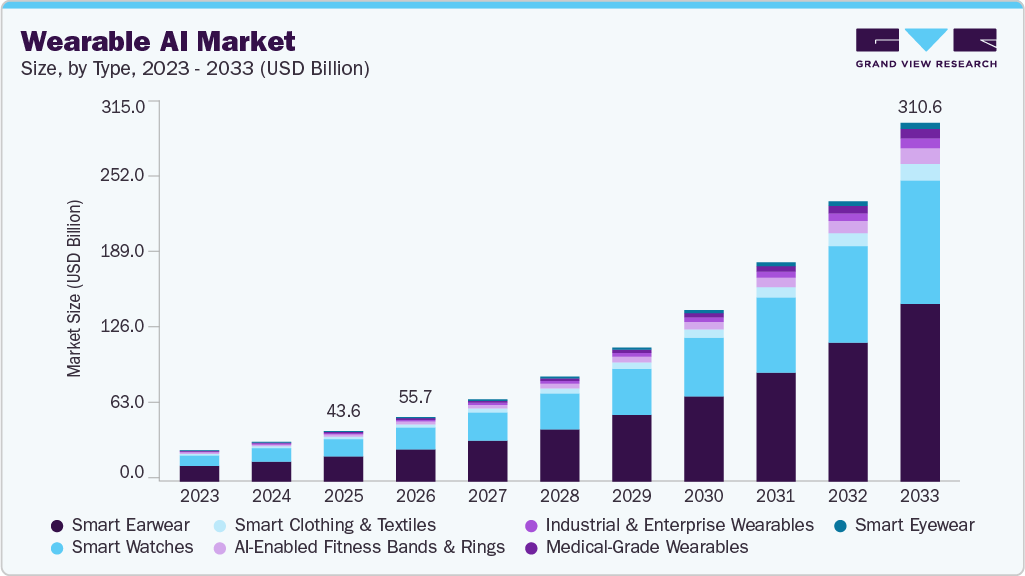
There is also a structural advantage. Organizations that integrate wearable AI early tend to redesign processes, roles, and governance frameworks alongside the technology. This alignment allows them to scale more smoothly as adoption grows. Late adopters often attempt to retrofit wearable AI into legacy structures, encountering resistance, fragmentation, and trust issues.
From a competitive standpoint, early adoption enables differentiation that is subtle but powerful. Customers experience more consistent service. Employees experience better support. Operations become more adaptive. These improvements accumulate gradually, making them difficult for competitors to identify and counter. Firms like Primafelicitas support enterprises in navigating this early adoption phase responsibly. By approaching wearable AI as an enterprise intelligence initiative rather than a pilot program, organizations can avoid common pitfalls and focus on building durable capability. The strategic opportunity lies not in being first to deploy devices, but in being first to design systems that turn human-centric AI into sustained advantage.
Wearable AI and Human-Centric Workforce Transformation

The new AI approach comes closer and changing the workforce that will work while having a connection with the people. Rather than taking action after execution, now enterprises will support employees in real time as per the environment, workload, and decision pressure. The evolution makes the intelligence being human-centric AI a strategic necessity, not a design preference, and it becomes more fundamentally strong as it is built around human behaviour and reduces the cognitive load instead of increasing it. These advances are not in terms of tech but Intelligence and evolution; they help the masses to get instruction when it is necessary and let them put wholly into judgement, problem-solving and collaboration. Consistent practising will let the system adoption happen quickly and ensure more consistent performance across teams.
From a workforce strategy perspective, wearable AI enables continuous capability development. Learning becomes contextual rather than episodic, and expertise is developed through daily activity rather than being limited to a siloed training model. Humans will be accountable decision makers, whereas AI will enhance the clarity and awareness of complex situations.
Augmentation Over Automation: How Wearable AI Strengthens Human Judgment at Work
One of the most important strategies is to understand the core responsibility ofwearable AI, which is enhancing people to do their job in a better way, rather than just replacing them. In complex enterprise systems, work is rarely a closed and shut case; actually, they are depends on context, experience, and awareness of the situation. These levels of awareness cannot be fulfilled by traditional automation, and the latest system accepts this reality by using AI to support human judgment rather than remove it. The Human-centric AI enhancement removes the employee’s mental stress and work overload by eliminating constant alerts or strict instructions. In place of that, accept guidance that is relevant to the situation. This helps people to respond in a real field situation while solving equations together harmoniously with the AI. And it works for handling, sensing, and data analysis in the background. From an enterprise’s lens, the new AI integration with the wearing aspect will protect institutional knowledge while increasing awareness instead of controlling actions.
Trust and Cognitive Balance in Wearable AI Adoption
Certain factors should be balanced and maintained their equilibrium within the changing AI ecosystem. The first factor is trust, which plays an important role as the new system works closely with the human body and continuously gathers contextual data. The evolving tech must be embraced by the people because it has been designed to support them, not keep poking over their heads. So once the trust is out of the space, then that becomes a morally suffering place.
The second factor is to ease the work rather than confuse and make it complex. Because once things got harder, nobody would switch at the place and still keep their traditional way of executing tasks, so it is really important to manage the load while giving the right instruction when it is necessary, rather than just beeping over every stage. So, making that structure a thoughtful design decision is needed that notifies users how issues are escalated and how experiences are personalized. It is a huge shift for the organization to get transparency, clear data Governance and employee involvement. When there is transparency, then humans keep a clear outlook towards the data decision-making and autonomy work. They will start engaging, so ultimately,human-centric AI is not only a technical challenge rather an organizational one.
Governance, Privacy And Risk At Scale
As wearable AI is scaling across enterprises with respect to, governance becomes a strategic necessity rather than a compliance exercise. The system captures sensitive data related to movement, environment and physiological state. Without tight governance, these systems start to put operations at risk rather than creating value. Enterprises must implement clear policies while handing over consent and in the retention process, and usage. Governance designed within a centric environment often falls short, so wearable AI needs governance that is adaptive and embedded into the system infrastructure.
Along with the governance, it is necessary to adopt privacy and risk management. The privacy will give a complete unified structure that changes the idea of trust, adoption and brand reputation. The privacy will help an organization to scale while keeping transparency, along with flexible restrictions. It creates a foundation for sustainable growth. Whereas risk management helps the enterprise to make a proactive plan in case of failure modes, biases and misuse of data. As you know, Wearable AI are introducing new dependencies among people, systems and environments. This is where enterprise AI partners like Primafelicitas add value by bridging the gap between wearable AI and governance, risk, and compliance expectations at scale.
Wearable AI: The Next Enterprise Advantage, If Built Right
Yes, it is the next enterprise advantage, as you have a billion-dollar opportunity over the next 3 years, and it is moving towards a fundamental shift in how enterprises design intelligence. Wearable AI has shown a convergence of strategy, operations, and human experience into a single, continuous system, and this changes the entire idea of intelligence to stay still on a computational system but makes it execute in real-time movement with people. Enterprises that recognize the fact that Wearable AI should be promoted as an architectural approach and implemented within the system that shapes how work is done and how value is created. Does not matter that you are delayed with implementing technology, but without the strategic coherence needed to fully capture its benefits.
So, in that way, Primafelicitas works with enterprises at this intersection and closely operates with human-centric intelligence, operational complexity and enterprise scale governance. The future of enterprise intelligence will be worn, contextual and continuous. If you are approaching this new design will define how your task is done tomorrow. Schedule a meeting here to discuss more.