
Why Battery Recycling Economics Is No Longer About Scrap, But About Data, Timing, and Control
Battery Recycling Economics are normally terminated where the process of recovery starts, where a battery ends up with a recycler, and the remaining value is ultimately recovered. It feels as though the appropriate place to gauge results, but it is often the route to erroneous results. When a battery is taken to be recycled, a big portion of its value has already been determined, and in most instances, unobtrusively diminished. Not that recycling is made inefficient. This is due to the fact that the process is initiated late.
A battery will go through several steps before it is sent to a recycler. It is produced, implemented, and operated under varying circumstances and transferred across multiple systems that often go unconnected. All these layers generate information, but by the time it is needed the most, very few bits of such information remain. The physical object is what is received by the recycler, but what is going around it is still not complete. It is at this point that choices start to be based more on reconstruction and less on clarity. Checking of material composition. Patterns of use are approximate. Even minor uncertainties start taking their toll on the way in which recovery is set. None of this appears to be a significant concern in itself. However, with time, it has an impact on the consistency of extracting value and the confidence with which it can be priced. The transition point is when this gap begins to close.
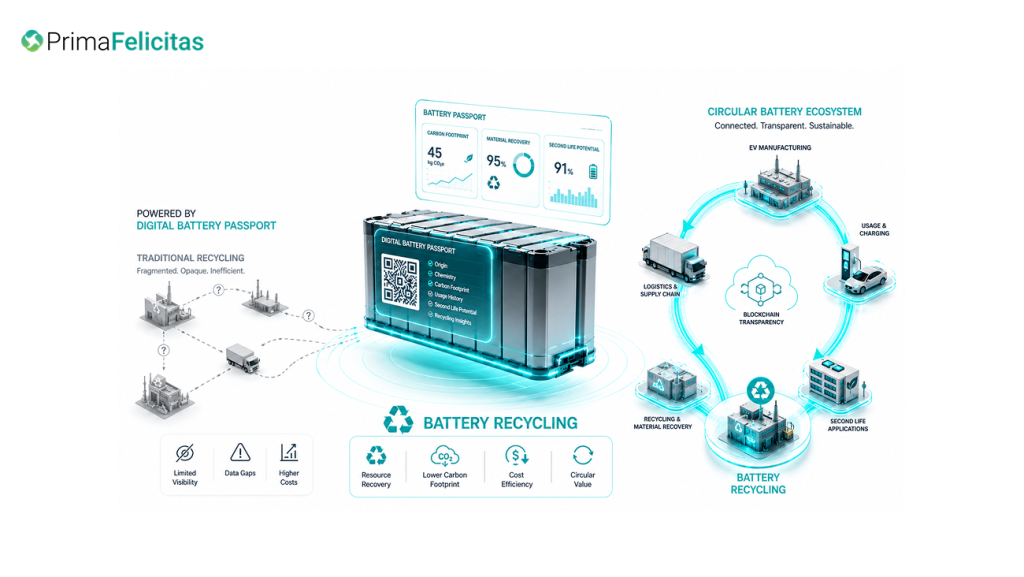
The recyclers do not have to begin with a blank slate when data must be carried forward in a systematic fashion. They will be able to go up to each battery with a better idea of the one they are approaching. The thing is that a part of the information about its origin, state, and history becomes incorporated into the process rather than something that must be rediscovered. Here is where systems such as a Digital Battery Passport begin to come in handy. Not through complexity addition, but by letting information flow with the asset and not fracturing at every step. In case of such continuity, decisions are less reactive and more deliberate. This eventually transforms the value-generation process.
Recycling remains more than a mere point where it collects resources. It is a juncture that makes previous visibility either empowering or restrictive. And, when that is seen, there is little to overestimate the degree of the outcome of what must be happening; of how much depends on what is actually sent to the recycler.
The Numbers Look Stable, But They Rarely Tell the Full Story
The models used to conduct most recycling activities seem to be effective. Estimates are made of inputs, the estimations of outputs, and the estimates are allowed to develop over a period of time to start believing that they have become accurate enough. Externally, the system appears to be stable. Recovery rates are within expectations, costs are controlled, and the margins appear to be predictable. In that picture, there is very little that creates the illusion that there is anything lacking. However, this feeling of stability can be traced to being enclosed within parameters never truly challenged by anyone.
Growing assumptions of those numbers are commonly based on what can be quantified at the point of processing, not all that was already done before the arrival of the battery. A recycler may be aware of what to do with a particular chemistry, but not what has been done with that battery. They could find the sense of composition of materials, yet not those changes that could happen with time and the real-world circumstances. They do not create a gap that leads to an instant failure, hence they are barely felt. Rather, they create decisions indirectly, impacting the aggressiveness with which value is sought or the protection it receives.
With time, such decisions start contaminating a pattern. The processes are structured to embrace uncertainty and not to eradicate it. Recovery plans are selected in a way that prevents risk, as opposed to being utilized to the maximum. Pricing is what is assured, not what may be possible with the benefit of hindsight. None of this is wasteful in itself, but it results in the creation of a system that is always conservative in the manner in which it extracts value. The fact that Battery Recycling Economics is conservative when it is grounded on incomplete visibility becomes a part of its interpretation.
What adds to this is that the variation is not always apparent. Both batteries may do the same task, and their results will differ, not due to the system failure but because the information involved was not complete in the first place. One is done with less correcting, and the other needs more verification, time, and money. The distinction is seldom credited with data, though this is where the distinction often starts. In this case, the lack of continuity becomes still more significant than the lack of information does.
There is data at lower levels, but information does not flow in a manner that is conducive to decisions in the future. A large part of that context must be recreated by the time recycling occurs, and reconstruction can never be as accurate as continuity. The larger the systems, the larger that gap is, just difficult to manage, not because processes are bad, but because they are starting with an imperfect starting point.
With an alteration in that starting point, the rest of the system is going to follow suit. It is here that such a concept as a Digital Battery Passport begins to relate the economics of recycling practically. It does not alter chemistry or the process, but it alters the amount of knowledge one has before making decisions. And that is the only thing that makes value approached, not at the end, but as soon as the battery is introduced in the system.
Whenever Visibility Comes Early, the whole outcome begins to change.
At some point in any recycling decision-making, there comes a point where things either start taking a certain shape. After a battery arrives at the facility, the process will go according to what is there. The system only responds to what it perceives, and it is there that most of the results are pre-determined. What seldom comes into question is what would change, given that the starting point itself appeared different. It is not a change in the recycling process that can lead to the shift. It is based on altering what is started by the process.
When the information is released prior to the battery going through the recycling process, the whole process starts to drift towards not reusing the process. Making things right in the end becomes unnecessary because recyclers begin with a more precise image of material composition, usage patterns, and condition. This does not completely rule out uncertainty, but it minimizes the necessity to make decisions based on assumptions.
The latter influences the usage of time. Planning is no longer only based on inspection. It starts in advance, having sufficient context to make decisions before the actual process occurs. This enables the recovery strategies to be designed with more purpose, and not to be refined on the course of progress. Even marginal gains at this point will start to affect the consistency with which value can be recovered. This shift is significant because it does not entail any change in capability. It requires a change in visibility.
When such visibility is institutionalised and taken on as a continuum, it starts to serve as a shared point of reference throughout the lifecycle. This is where a Digital Battery Passport will begin to leave the documentation behind and join the decision-making process. It does not complicate the process. It makes the gap between the known and what is to be established smaller.
This difference becomes more evident when the batteries are tested on more than a short-term recovery. All batteries cannot be recycled immediately. Others have sufficient residual value such that they can be used over an extended time. The lack of trustworthy information postpones or evades that decision. Being more visible, one can contemplate the assessment more clearly, and avenues like Second Life Batteries can be regarded more confidently. This gradually starts to affect the system in its entirety.
Recycling is no longer a one-step process. It gets integrated into a wider stream in which the previous knowledge influences subsequent results. Decisions seem less reactive as they are no longer commencing with uncertainty. This procedure remains the same; however, the manner in which it is guided also starts to shift. And then, when that change establishes itself, it proves hard to revert to a system based on rediscovering what might have been familiar in the first place.
Where Value Stops Being Recovered and Begins to be Made.
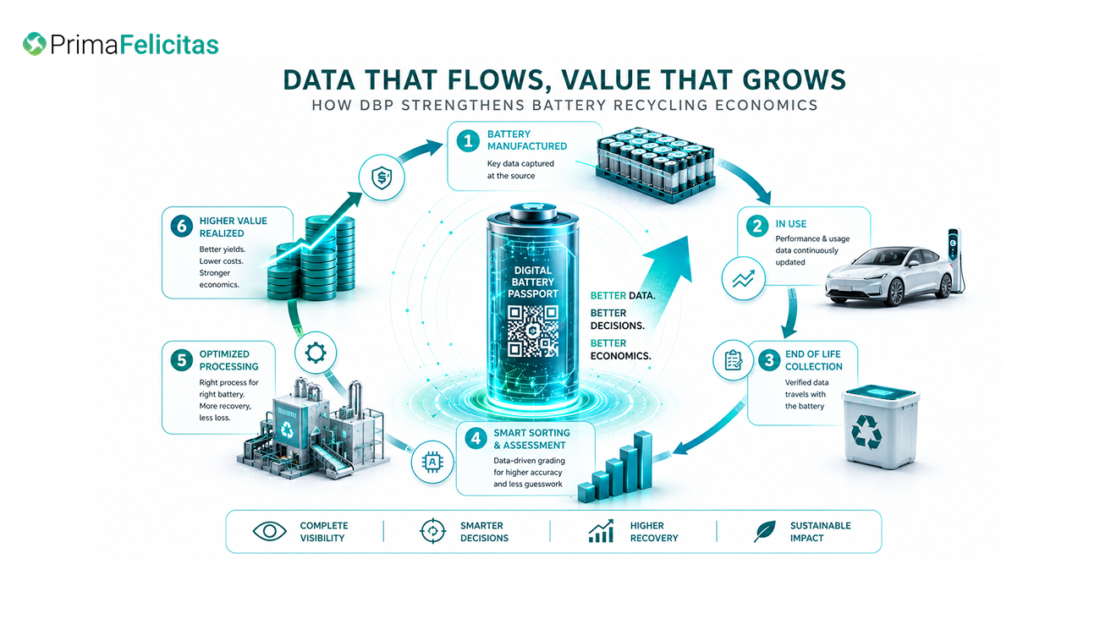
So far, the majority of Battery Recycling has been construed as being recycled in terms of recovery. The process is at the end of which materials are extracted, outcomes are measured, and its efficiency is judged. That model is effective, albeit silently constraining the understanding of value. It presumes that all that happens is crucial during the last stage, yet in reality, there is much that is determined before that last stage. The process does not change, but the way decisions are made at the asset before entering into recovery.
As the previously recognized visibility increases, recyclers are ceasing to be responsive to what comes their way. The decisions they begin to make are contextual. A battery is not only processed but also analyzed. The damage, history, and possible directions are examined prior to one of the recovery actions being taken. That transformation alters how the value is approached since it introduces the aspect of choice, where execution was the sole issue in the past. Systems such as a Battery Traceability System start to play a real role here. They never alter the way materials are recovered, but they alter the extent to which each asset is comprehended prior to the recovery choices becoming clogged in. Once such understanding is enhanced, then the process will cease to rely on safe assumptions, but rather proceed in a direction of being informed.
When batteries are not considered a single result, that difference is made even more apparent. Other batteries enter the second sort of recycling since it is still the most effective. But others, which have sufficiently residual performance, may be markets to be used over the long term. When underpinned with structured information, avenues like Second Life Batteries are no longer risky options. They are placed in a larger value approach, and the timing and usage are matched with the state of the property.
In the long run, it starts redefining the perception of Battery Data Management in the lifecycle. Data is not an isolated system anymore. It joins the channel of value orientation. Consistency in information that can be used at all stages enables a decision to be based on the one made previously. Instead of worrying about what’s gone, focus on how to make the best use of what remains. It is here that the effect begins to show in results.
More consistent realisation of value starts to be determined by improved routing choices, better assessment, and less doubt. The system is made more adaptive instead of the assumption that recovery will follow certain challenging circumstances. It is that flexibility that begins to build up Battery Recycling Revenue, not with the help of some single tweaking, but with the process of more precise decisions. With the development of this approach, the role of recycling starts to change.
It is no longer the last phase where value is lowered to materials. It is transferred into an ongoing process wherein value may be further extended, re-allocated, or optimized based on the level of understanding it. Change is not abrupt, yet its effects can be seen in the way things get better over time. And when that shift in the balance is achieved, then recycling can no longer be simply what it reclaims. It is characterized by its ability to utilize what it already knows well.
The Market Is Moving, and the majority of people just have not changed with it yet.
The change in the industry does not appear to be dramatic. It has no one point when the switch comes, and the switch goes. Rather, it is occurring silently in various sections of the ecosystem. More structured information is being retained by the manufacturers. Mates within the supply chain are expecting more transparency. Recyclers are beginning to understand that what they get is a part and not the whole of the story.
One by one, these changes can be minor. They are jointly starting to change the way the system functions. A very apparent change is in the treatment of data. It is no longer perceived as one that complements reporting. It is beginning to impact lifecycle decisions. When information flows in a useful manner, this minimizes the necessity to reconstruct knowledge at every level. Such continuity will enable various players to work with increasing confidence, even where they are working with different systems.
This is where the notion of a united Battery Traceability System starts to transition into reality. The difference is beginning to be felt by recycling people, specifically the recyclers. The classical model was based on inspection and correction in the end stage. Towards knowing more before that point is a growing push now. Not as a theoretical advantage, but to minimize variability and enhance consistency. As soon as such visibility is enhanced, processes start leveling in aspects that were never achievable prior to this.
Concurrently, the regulating force is contributing to this change. The entry of requirements related to lifecycle information and disclosure is driving the industry towards more systematized practices. One of the elements of compliance here is not a Digital Battery Passport only. It is integrating into the expected flow of information through the system. A regulatory requirement would sometimes turn into an operational benefit to those who it works to their early advantage.
It is here that the change is initiated to be directly related to business results. Making decisions more frequently and consistently, with a stronger visibility of the recyclers, makes it possible to plan, minimize uncertainty, and make decisions. That does not merely enhance efficiency. It enhances the predictive and scaling ability of the outcomes. In the long term, it starts to affect the way Battery Recycling Economics is determined since the system itself is more predictable.
Migration to the Circular Battery Economy is also beginning to take shape. It is no longer simply a question of maintaining materials in use. It concerns guaranteeing that the value flows sufficiently clearly to be managed in an effective manner. Batteries are no longer going through discrete phases. They belong to a chain of information in which information will be at the center stage on how they are utilized, re-utilized, or re-used.
This movement can be more easily read when looking towards 2030. The discontinuity between the systems, in which data is connected, and systems in which it is not, will become more apparent. Recyclers, who will adapt early, will not only enhance their procedures. They will become decision-makers in that loop, and not participants at the opposite end of that loop. That change is not going to happen overnight, but it is in progress. And as soon as the system starts practising the idea of visibility rather than reconstruction, it comes to favour models that are older than those in the same arena.
The Advantage Is Decided Before Recycling Begins
Rather than concentrating on the past, thinking about what has gone, focus on how to best utilize what comes along. The thing that is evolving in this case is not the recycling process itself. That is what the process begins with. Battery Recycling Economics have long been evaluated in terms of recovery. Nevertheless, the result is predetermined long before. When the point of departure is ambiguous, then everything else will readjust around it. This is starting to change.
Decisions are not the same when a battery is promoted into the system with useful context. Less rechecking. Fewer assumptions. More direction. It is where systems constructed based on a Digital Battery Passport and an attached Battery Traceability System begin to become really effective, not on paper but in the consistency of appearance of value. This is the place where the transition to a Circular Battery Economy turns into something feasible, rather than merely theoretical. When you still need to work with reconstruction in its last stage, then it is already a handicap for you.
Get in touch with Stop losing value at the recycler. See how a Digital Battery Passport improves Battery Recycling Economics by turning missing data into strategic revenue. to create a Battery Passport Service that leaves your data intact- and your decisions in your future.
